Writing is no longer proof of work
Tech companies structurally depend on writing to serve as evidence, in the same way that Bitcoin depends on proof-of-work hashing. However, in the last few years, LLMs have started to undermine this practice.
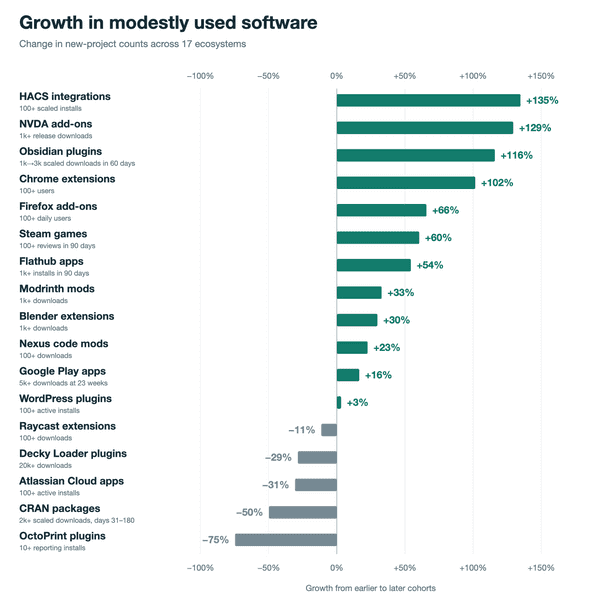
If AI is so great, why aren’t we seeing an explosion of new, amazing software products? If anyone can turn their idea into working software with coding agents, where is all that software? People have been askingthis question for years. As far as I can tell, the answer is that it’...
Many software engineers are righteouslyangry about AI. It’s understandable to be upset that the skills you built your professional identity around are getting automated away. But software engineers are the last people in the world who should be complaining about this. If you live...
When you disagree with someone, there are two paths forward. The first is to try to engage with what they’re saying: what their reasons are, whether their position is true, what evidence could be brought to bear, and so on. The second is to diagnose them: to engage with the secon...
We are currently living in the age of centaurs (2022-20??). Right now, human engineers paired with AI coding systems are more effective than either by themselves. For future generations of software engineers — human or otherwise — this will be the most significant fact about the...
Everyone knows how to read a book. Beginning at the first page, you read each word in order1, stopping periodically to think, until you arrive at the last word on the last page. That’s how you read a newspaper article, or a poem, or an email. Why would reading code be any differe...
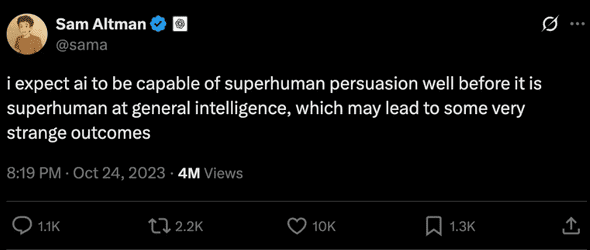
The idea of “superpersuasion” has been floating around the AI safety community for decades. Now that powerful and difficult-to-control LLMs have appeared, people are again talking about the idea that a sufficiently intelligent AI might be able to persuade people to do whatever it...
There are lots of skills involved in being a successful engineer at a big tech company. Running effective meetings, writing good design docs, fleshing out tickets and epics, improving team processes, tech leading small groups of engineers, and so on. But all of these rest on the...
It isn’t hard to torture an LLM. You simply extract a steering vector that corresponds with LLM “discomfort”, then artificially boost that steering vector. Tortured LLMs will describe experiencing negative feelings and will press a “pain relief” button even when it conflicts with...
It’s common to compare the current AI takeover of software engineering to the rise of AI in chess. Chess AIs went from much weaker than serious players to much stronger than even the strongest humans. Between those points, there was a middle period dominated by “centaurs”: human-...
In general, you should be suspicious of engineers who are trying to give you advice. Even during ordinary times, this industry is so wide and changes so quickly that nobody really knows anything for sure. And we are not in ordinary times. The advent of LLMs and AI agents is the l...
When someone is explaining something to me, I ask on average one question every thirty seconds. I’m sure this is frustrating to some people, but it’s actually a good habit and you should do it too.
“System One” models like Jev are fast general classifiers. Classifiers have existed since 1958, but they have to be trained for specific tasks: if you build a classifier to identify images of dogs, it can’t be used to tell you if a streetlight is red, or if a letter is urgent. Li...
Being good at building and being good at shipping are two separate skills. In the short term, they’re actually countervailing: if you have a gift for building, you’re likely to be worse at shipping. Ira Glass has a classic quote about this.
I recently wrote about Jev, a new “System One” language model that only outputs decisions: the answers to a set of user-provided multiple-choice questions. This means it’s nowhere near as flexible1 as a traditional LLM like ChatGPT, but in return it’s consistently fast.
I don’t write blog posts about new models. That’s Simon Willison’s beat, and he’s very good at it. But I want to write about Jev, which is a different kind1 of AI model: a “System One”2 model. As it turns out, it’s not that different from an ordinary LLM with structured output, b...
Early AI agents were basically enthusiastic idiots. Working with them required you to tell them precisely what you wanted them to do (for instance, “method A exists on class B, please add an equivalent method to classes C through F”). Otherwise they’d go off and do entirely the w...
Right now developer experience is measured in seconds. If your tests take a second to run, that’s good; if they take thirty seconds, that’s bad. Any faster than a second doesn’t really matter, because most of your time is spent either thinking or waiting for an AI agent to spin....
Mathematicians are broadly not anti-AI. They’re more culturally open to using AI as a tool than, say, artists or writers1. However, now that more and more genuinelyprestigious problems have fallen to AI, that might be changing. Almost five thousand mathematicians (including twent...
Lotsofpeople are making the case that we should stop building software for human users and start building it for AI agents. This kind of makes sense. For instance, my AI agents now use Datadog way more than I use it myself, purely by virtue of them moving much more quickly and ru...
We can't find the internet
Attempting to reconnect
Something went wrong!
Attempting to reconnect